Posts

What Makes up the Kakuma Refugee Camp and Kalobeyei Settlement?

Image
 For so many years, and in many fundraising posters and images, the picture portrayed of a refugee camp in Kenya is that of an establishment of hopeless, malnourished and naked children in a dusty and bare land. Some images show older people, mostly women lined up behind some fences, seemingly waiting for aid workers' help, who in this case are UNHCR officers. But that is not the factual reflection of a refugee camp. In reality, it is made up of so many things: different nationalities, schools, hospitals, markets, hotels, and even fish farms. A refugee camp like Kakuma, which has been in place for at least 30 years is a melting pot of cultures and a beehive of activities.  Reception area in Kalobeyei, Kakuma. This does not mean, however, that it is a pleasant place. As much as it is meant to be a place of protection and care for the thousands fleeing conflicts and persecution, it is also a mechanism of control where refugee lives are in constant risk of abuse, both by the host...

Celebrating World Refugee Day in Kakuma-Kalobeyei: Hope away from Home

Image
The World Refugee Day 2023 (WRD), under the theme of 'Hope away from Home' was celebrated in Kalobeyei Integrated Settlement in Kakuma, Turkana County. Although the occasion was slated to take place on 20th June, in Kakuma, it was held on 19th, to pave way for national celebrations which took place in Nairobi.  Refugees from the Nuer Community waiting to perform at the WRD in Kalobeyei. In Kalobeyei, the day was marked in Village 2, and was graced by the Turkana County Governor, Hon Jeremia Lomurkai, the UN Refugee Agency Commissioner, Filippo Grandi, the Executive Director of the UN Habitat, Maimunah Sharif, Kenya's Principal Secretary for Immigration and Citizens Services, Hon Julius Bitok, the Commissioner General of the Department of Refugee Services, Hon John Burugu, the area Member of Parliament, Hon Epuyo amongst others.  During the event, the key message which was emphasized by most of the speakers was the promotion of self reliance for refugees and host communities...

Kakuma Culture: Home away from Home

Image
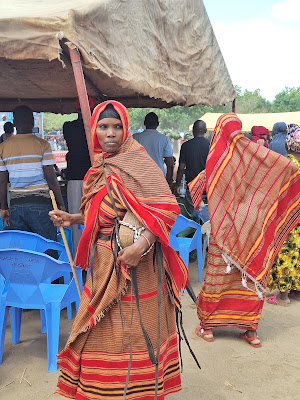
 On June 11th, Kakuma Sound, which is an organization that organizes traditional events for refugees , organized a cultural festival for both refugees and the host communities to showcase their talents through traditional dances and songs. Through this event which is organised annually, both the refugees and host communities learn from each other, share stories and experiences, thus appreciate one another and coexist peacefully. It is generally an attempt to promote social cohesion in a culturally diverse and displacement context. For refugees, however, it is a ceremony that reminds them of home (their countries of origin), and a way through which they keep their cultures alive in contexts where they might be faced with the pressure to adopt the culture of their hosts or assimilate. It is also a moment where they come together as a community to appreciate the cultural diversity within the camp. For the young ones who are born in the camp, the event is an opportunity to learn about ...

The Turkana People and Culture: Pastoralism, Cattle Raiding and Peace.

Image
 As a community, the Turkana people rely mainly on Pastoralism which involves keeping livestock as their primary source of livelihood. This livestock also serve economic and cultural purposes as they symbolize economic status and are used in traditional events such as dowry ceremonies. Socio-culturally, pastoralism is a measure of social status in among the Turkanas and it functions as wealth, dowry payment, and settlement of disputes. Picture of Turkana pastoralist homestead (Manyatta). While this practice is responsible for the survival of the Turkana in a climatically hostile region, it has, over the years, also been characterized by dangers emanating from the conflicts over scarce water and pasture, which are essential in the region. Furthermore, frequent cattle raids between the pastoralist communities in Kenya's Northern region and cross-border communities in South Sudan, Uganda, and Ethiopia also pose a significant risk and often lead to mutual suspicion of neighbouring...

From ‘Down Kenya’ to the North: A journey from Nairobi to Lodwar.

Image
 Lodwar town, the administrative capital of Turkana County, is located in one of Kenya's most marginalized and remote places. Situated in the North-Western parts of Kenya, the town hosts the headquarters of the Turkana County Government and is a commercial hub buzzing with all kinds of businesses, mainly spurred by the presence of refugee camps in the nearby Kakuma town. It has an airport, usually used by humanitarian workers employed by various NGOs in the Kakuma refugee camp, government officers and others to travel to other parts of Kenya, mainly the capital city of Nairobi.  One of the buses ferrying passengers from Nairobi to Lodwar   To understand Turkana County, a little historical background is vital. It is popularly known as the 'Cradle of Mankind' following the discovery of early human fossils, particularly the 'Turkana Boy’ in Nariokotome near Lake Turkana in 1984, which is the most complete early human skeleton ever found. It is mainly inhabited by the Turka...